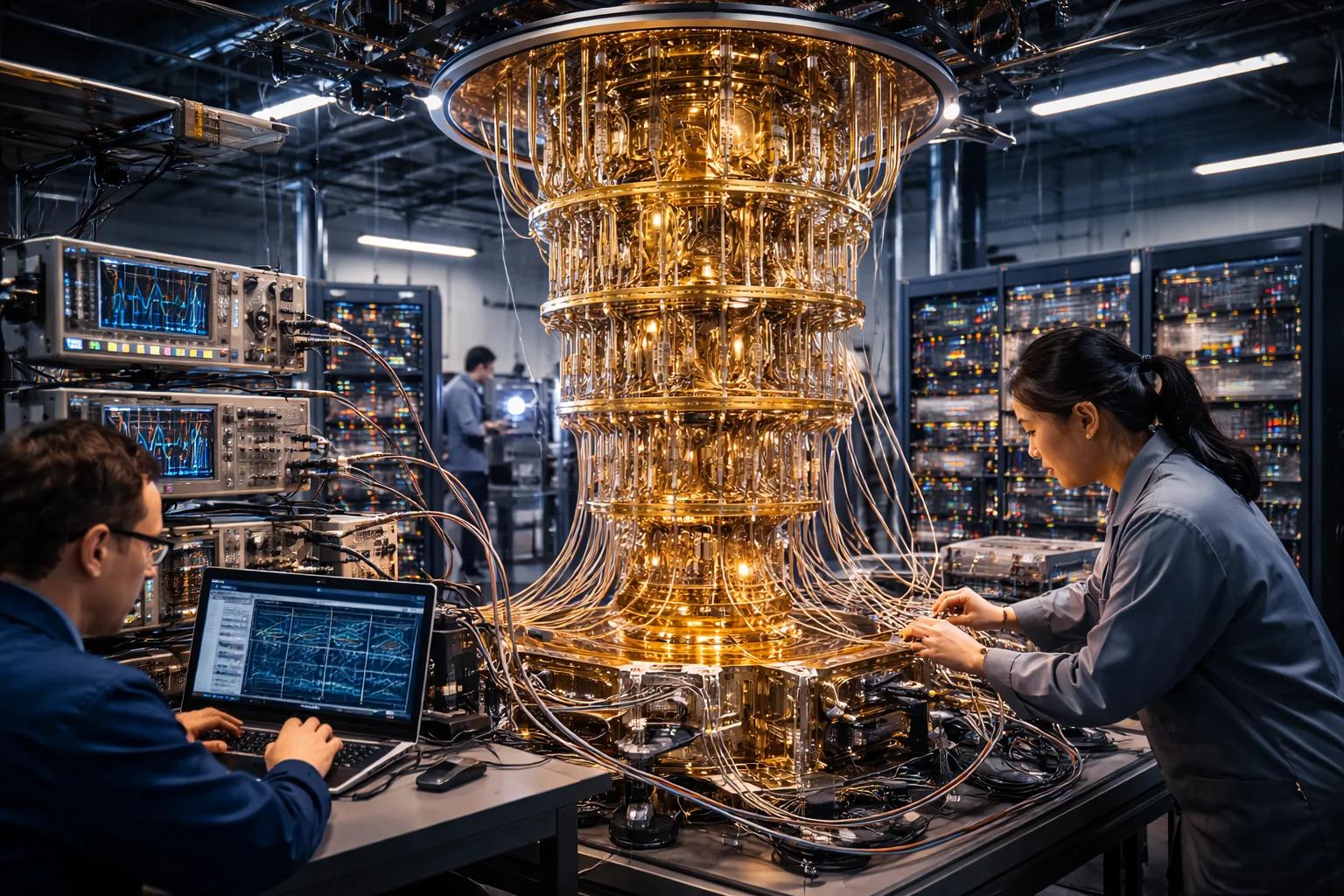
Artificial intelligence is moving beyond writing content, answering questions, and generating computer code. Researchers are now exploring how AI models can help solve complex scientific and mathematical problems that traditionally require specialized human expertise.
On October 16, 2026, Anthropic published new research showing how its Claude AI model helped design more efficient quantum circuits. The research focused on eight computational tasks related to chemistry, optimization, physics simulation, number theory, and numerical computing.
According to Anthropic, Claude discovered circuit designs that improved on previously published approaches. In one particularly notable result, the company reported that Claude reduced the number of operations required for a key step in a quantum optimization algorithm by approximately 12 times.
The findings suggest that AI could become a valuable tool for developing more efficient quantum algorithms. However, the results do not mean that practical, large-scale quantum computers are already available.
What Are Quantum Circuits, and Why Do They Matter?
Quantum computers are different from traditional computers in how they represent and process information.
Conventional computers use bits, which represent either 0 or 1. Quantum computers use quantum bits, commonly called qubits, which can take advantage of quantum properties such as superposition and entanglement.
These properties allow quantum computers to approach certain computational problems differently from classical machines. Researchers are investigating their potential applications in chemistry, materials science, cryptography, and complex optimization.
Quantum circuits are the building blocks that tell a quantum computer which operations to perform. They consist of sequences of quantum gates that transform the states of qubits to carry out a calculation.
Designing these circuits efficiently is difficult. Quantum computers have limited resources, and qubits are highly sensitive to environmental disturbances. Errors can accumulate during a calculation, while additional gates and qubits can increase the cost and complexity of running an algorithm.
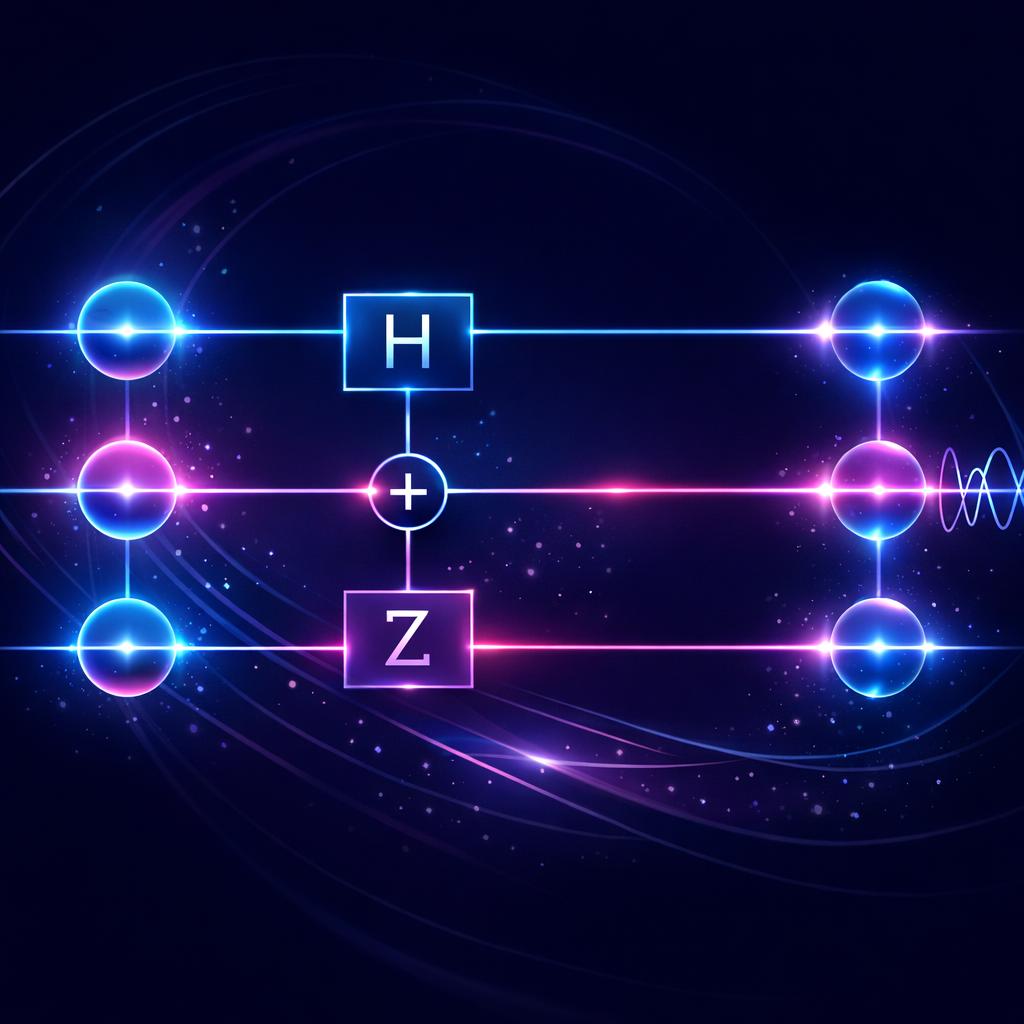
A more efficient circuit can reduce the resources required to perform the same calculation. This is why improving circuit design is an important part of quantum computing research.
How Anthropic Used Claude to Design Better Quantum Circuits
Anthropic researchers approached quantum circuit design as a problem that AI could explore through programming, experimentation, and mathematical reasoning.
Instead of asking Claude to make small adjustments to existing circuits, the researchers provided plain-language descriptions of eight computational tasks. They also gave the model access to an automated evaluation system.
The process worked through a repeated cycle:
Describe the problem: Researchers explained what each quantum circuit needed to calculate.
Generate a design: Claude proposed a circuit implementation using code.
Check correctness: An independent evaluator tested whether the proposed circuit produced the required result.
Measure efficiency: The evaluator assessed the circuit's resource requirements, including qubits and quantum gates.
Improve the design: Claude used the feedback to develop and test further approaches.
This feedback loop allowed Claude to explore different designs without requiring a human researcher to intervene between every round.
The researchers reported that Claude's work went beyond simply adjusting existing solutions. In some cases, it identified alternative mathematical approaches or reorganized calculations to avoid unnecessary operations.
The results demonstrate how AI can help explore a technical design space in which proposed solutions can be tested against clear mathematical requirements.
Major Findings: Eight Quantum Circuit Design Tasks
Anthropic evaluated Claude across eight computational tasks involving several areas of quantum computing.
The work included calculations relevant to chemistry, optimization, quantum simulation, number theory, and numerical computing. The company reported that Claude found improvements over previously published circuits across these tasks, with seven of the eight showing reductions in both qubit and Toffoli-gate counts.
Toffoli gates are an important type of operation used in quantum circuit resource estimates. Counting these gates can help researchers compare the computational costs of different designs.
One example involved simulating FeMoco, an iron-sulfur molecular cluster found in the enzyme nitrogenase. Understanding this cluster could help scientists investigate how biological systems convert nitrogen into ammonia, with possible implications for industrial catalysts and chemical production.
Anthropic described how estimates for simulating the same 54-orbital FeMoco model had fallen from approximately 50 trillion Toffoli gates in a 2017 estimate to around 340 million in later work.
That reduction came from years of algorithmic improvements across the research community, not from Claude alone. It illustrates why efficient circuit design matters: reducing computational requirements can make previously impractical scientific calculations more realistic for future quantum hardware.
Claude's contribution was to identify additional ways to reduce resource requirements in selected computational routines.
A 12-Fold Reduction in a Quantum Optimization Step
One of the most significant findings concerned a quantum optimization algorithm called decoded quantum interferometry, or DQI.
Optimization problems appear in many areas, including scheduling, logistics, engineering, and materials research. They involve finding solutions that satisfy multiple constraints or perform well according to a particular objective.
The DQI approach includes an error-correction decoding step that can account for a substantial share of its computational cost.
Anthropic asked Claude to develop a more efficient quantum circuit for this step. The model moved away from an approach based on the extended Euclidean algorithm and instead used a method based on Berlekamp–Massey decoding.
The researchers then refined the design to reduce the need to store intermediate information. Rather than reserving large amounts of quantum memory for every possible situation, the circuit reconstructed much of that information when needed.
According to Anthropic, these changes reduced the number of gates in the decoder by a factor of 12 compared with the previous construction.
This is an important distinction: the result concerns a particular step in a specific quantum algorithm, not a 12-fold improvement in every quantum computer or quantum calculation.
Nevertheless, reducing the cost of an expensive computational component could make a larger algorithm more practical if the improvement carries over to a complete implementation.
Why Quantum Circuit Design Is So Difficult
Quantum circuits face constraints that ordinary computer programs do not.
A conventional program can use conditional statements, overwrite temporary values, and discard information once it is no longer needed. Quantum circuits must respect different rules.
For example, quantum operations must be reversible in the relevant circuit model. Temporary information cannot simply be erased in the same way as ordinary computational memory.
This creates a trade-off between memory and computation. A circuit can retain intermediate results to avoid calculating them again, but this requires additional qubits. Alternatively, it can reconstruct or recalculate those results, which may require more gates and additional processing time.
Claude's work explored ways to balance these competing requirements.
In the elliptic-curve arithmetic task, the model spent approximately 53 hours exploring the point-addition problem with minimal human input between rounds. Anthropic reported that it developed a new approach to modular inversion, a computationally expensive part of this calculation.
The work involved mathematical reasoning, testing candidate designs, and validating the resulting approach. Researchers also used formal verification tools to check important mathematical claims.
This illustrates a potentially valuable role for AI in scientific research: generating ideas is only one part of the process. Proposed solutions must also be tested and shown to satisfy the requirements of the problem.
What Could This Mean for Future Scientific Discoveries?
More efficient quantum circuits could eventually help researchers make better use of limited quantum hardware.
Several areas could benefit if these improvements translate into practical, full-scale quantum computations.
Drug discovery and chemistry: More efficient quantum simulations could help researchers investigate molecular behavior and chemical reactions. This may support the development of medicines and new chemical processes, although real-world applications require further research.
Battery and materials research: Quantum computing could help scientists study complex molecular and material properties. Better circuit designs may reduce the resources needed for certain calculations.
Industrial chemistry: Improved simulations could contribute to understanding catalysts and chemical processes, potentially supporting more efficient manufacturing and fertilizer production.
Optimization and engineering: More efficient quantum algorithms could help researchers investigate difficult optimization problems involving many constraints.
Cryptography: Some quantum algorithms are relevant to mathematical problems used in cryptography. Better circuit designs could affect estimates of the resources needed to run these algorithms on sufficiently capable quantum computers. This does not mean current encryption has suddenly become breakable.
These are potential long-term applications rather than immediate outcomes of Anthropic's experiment. Practical benefits will depend on hardware progress, error correction, algorithm development, and independent verification.
Can AI Accelerate Quantum Computing?
The research offers an example of how AI might contribute to scientific progress by helping researchers explore solutions that are difficult to discover manually.
Quantum circuit design is particularly suitable for this kind of approach because circuits can be represented as code, tested against mathematical requirements, and compared using measurable resource costs.
An AI model can generate multiple candidates, learn from evaluation results, and investigate alternative strategies. This can help researchers explore more possibilities than they might examine through a purely manual process.
However, AI-generated designs still need rigorous validation. A model may produce incorrect reasoning, overlook constraints, or find a solution that performs well under a particular benchmark without being useful in a real system.

Anthropic's research also describes limitations in Claude's search process, including a tendency to favor familiar methods and repeatedly check apparent improvements. The researchers used instructions encouraging different approaches to broaden the search.
These details matter because AI-assisted science is not simply about replacing researchers. It is about combining automated exploration with objective testing, mathematical verification, and scientific judgment.
Limitations: What the Research Does Not Prove
Although the findings are promising, several important limitations should be understood.
First, the reported results concern circuit designs and resource estimates. They do not establish that Claude has built a quantum computer or demonstrated all the proposed improvements on operational quantum hardware.
Second, the research examines eight selected computational tasks. Results from these benchmarks cannot automatically be generalized to every quantum algorithm or scientific problem.
Third, a more efficient circuit does not by itself solve the wider challenges of quantum computing. Hardware must still support enough reliable qubits, manage errors, and execute the required operations within practical limits.
Finally, the work was published by Anthropic as research accompanied by a technical preprint. Independent replication and further evaluation will help establish how broadly the methods can be applied.
The findings should therefore be understood as a research advance in algorithm and circuit design, rather than proof that large-scale quantum computing is ready for everyday use.
Final Thoughts
Anthropic's quantum circuit research highlights a growing role for AI beyond conventional digital tasks. By generating designs, testing them through an automated evaluator, and refining its approach, Claude helped researchers discover more efficient implementations for several specialized quantum computations.
The reported 12-fold reduction in the gate count of a key decoding step is one example of how changing an algorithm's structure can reduce computational requirements.
If these techniques continue to improve and prove useful on future hardware, AI-assisted circuit design could contribute to progress in chemistry, materials science, optimization, and other research fields.
The broader lesson is that scientific progress may come not only from building more powerful computers, but also from discovering better ways to use the computing resources already available.
Sources and Further Reading
Anthropic — Designing More Efficient Quantum Circuits with Claude
https://www.anthropic.com/research/designing-efficient-quantum-circuitsarXiv — Discovering State-of-the-Art Quantum Circuits with Large Language Models
https://arxiv.org/abs/2610.22367